Systems Thinking Workshops
See the whole. Understand the connections. Explore possibilities for change.
Complex challenges rarely have a single cause. They emerge through interconnected relationships, recurring patterns, underlying structures, assumptions, and feedback across a wider system.
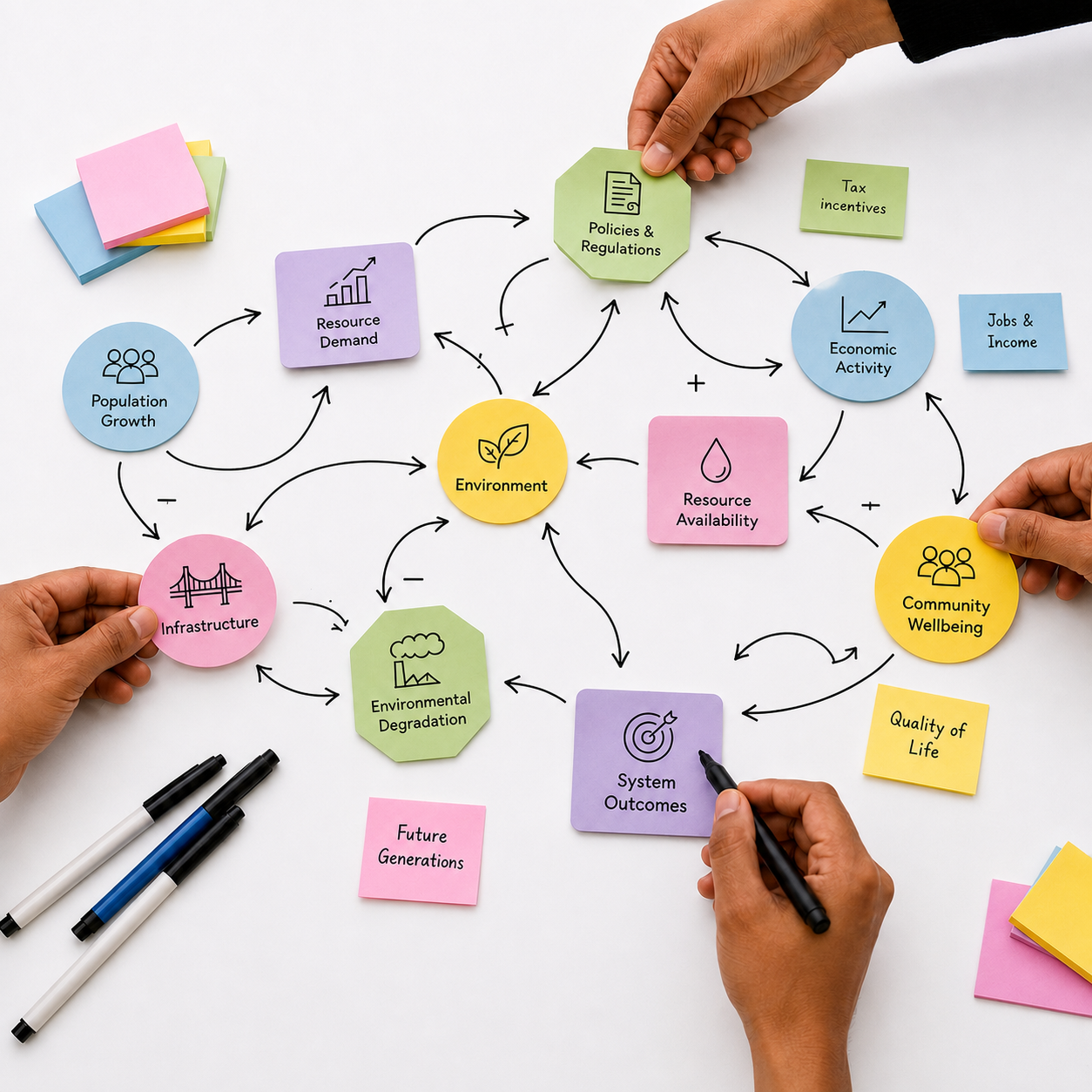
Our Systems Thinking Workshops create a structured, participatory space to explore that bigger picture. Through systems mapping, facilitated dialogue, and reflection, participants make connections visible, bring different perspectives into the room, and develop a deeper understanding of the challenge they are working with.
What is Systems Thinking?
See the system around the challenge
Systems thinking is a way of understanding complexity by looking beyond individual events to the patterns, relationships, structures, and feedback that shape what happens over time.
Rather than examining parts of a challenge in isolation, it helps participants explore how those parts interact, influence one another, and contribute to outcomes over time.
The result is a shift from seeing individual problems to understanding the system around them.
Complex challenges are interconnected
Today's organisational, social, educational, and sustainability challenges are increasingly interconnected. An action in one part of a system can influence outcomes elsewhere, while a solution that works in the short term may create unexpected consequences over time.
Systems thinking helps participants recognise patterns, uncover interdependencies, surface assumptions, and consider consequences before moving towards possibilities for change.
Core Capabilities
Four capabilities that transform how people see problems

Seeing Patterns
Develop the ability to see recurring patterns of behaviour over time moving beyond events and symptoms to understand the deeper structures producing them.

Understanding Feedback
Learn to identify reinforcing and balancing feedback loops the engine of growth, decline, and stability in every system you encounter.

Mental Models
Surface and examine the assumptions, beliefs, and frames that shape how we see and inadvertently limit our understanding of complex situations.

Leverage Points
Identify the places in a system where a small shift can produce lasting change moving from reactive problem-solving to strategic, systemic intervention.
The Workshop Journey
Explore the system together
Look beneath the surface.
Participants move beyond the immediate issue to explore patterns over time, underlying structures, and the assumptions shaping how the challenge is understood.
Make the system visible.
Participants map relationships between important elements of the challenge, exploring system boundaries, interdependencies, and feedback that can be difficult to see separately.
Bring perspectives together.
People experience and understand the same system from different perspectives. Facilitated dialogue brings those perspectives into the room and surfaces assumptions.
Make sense of what emerges.
Participants step back from the system they have mapped to notice patterns, tensions, feedback, and potential consequences, turning mapping into deeper insight.
Explore possibilities for change.
With a broader understanding of the system, participants explore potential points of leverage, consider possible consequences, and identify directions for action.
What Can We Explore?
Work with the complexity that matters to you
Strategy & Organisations
Explore the relationships, patterns, and structures influencing strategy, organizational change, and decision-making.
Leadership & Teams
Examine how behaviors, relationships, and assumptions interact within the wider system in which teams operate.
Sustainability & the SDGs
Explore connections across environmental, social, and economic dimensions and consider wider system consequences.
Education & Learning
Engage learners with complex real-world challenges and develop their ability to recognise connections beyond linear thinking.
Policy & Public Challenges
Explore stakeholders, relationships, feedback loops, and consequences across complex public and societal systems.
Research & Complex Problems
Frame complex questions, surface assumptions, and make hidden relationships easier to see and examine.
Every system is different. So is every workshop.
Bring a challenge. Explore the system. Discover where meaningful change might begin.